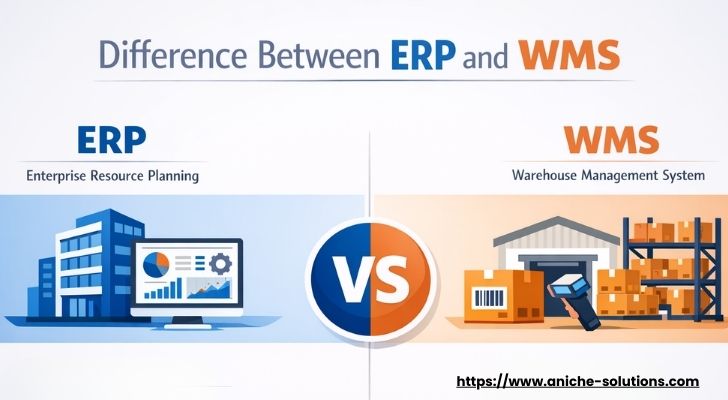
Many businesses today get confused between erp vs wms when they plan to improve their operations. Both systems help companies manage work in a better way, but their purpose is different. Some people think they are the same, but that is not true.
An ERP system vs WMS comparison becomes important when a company is growing and facing issues in inventory, warehouse handling, finance, or order processing. ERP manages the overall business process, while WMS mainly focuses on warehouse activities.
In this blog, we will clearly explain the difference between wms vs erp, their features, benefits, and when you should choose one for your business. This will help you make the right decision without confusion.
An Enterprise Resource Planning system, also known as an ERP system, is business management software that helps companies manage their daily operations in one place. It connects different departments like finance, sales, purchase, inventory, and human resources.
ERP works as a central system where all business data is stored and shared. This means every department can access real-time information. When the sales team creates an order, the finance and inventory teams can see the same data instantly. This reduces errors and improves coordination.
When people compare erp vs wms, they should understand that ERP covers the complete business process. It is not limited to warehouse tasks. In a simple way, ERP helps you manage the entire company from a single platform.
Centralized Data Management – ERP stores all business information in one system. All departments work on the same data, which reduces mistakes and avoids duplicate entries.
Finance and Accounting Management – ERP tracks sales, purchases, expenses, taxes, and financial reports. It gives a clear picture of company performance and cash flow.
Inventory and Order Management – ERP monitors stock levels, manages purchase orders, and processes sales orders. It helps control inventory and avoids stock issues.
Human Resource Management – ERP manages employee records, payroll, attendance, and other HR activities in one place.
Reporting and Analytics – ERP provides detailed reports and business insights. Managers can check performance and take better decisions based on real data.
Improved Coordination Between Departments – ERP connects sales, finance, inventory, and HR in one system. Teams can see the same data, which reduces confusion and improves teamwork.
Better Data Accuracy – ERP stores information in a single database. This reduces manual errors and duplicate entries.
Higher Productivity – ERP automates daily tasks like billing, reporting, and stock updates. Employees save time and focus on important work.
Real-Time Business Visibility – ERP provides live reports and dashboards. Business owners can check performance anytime and take quick decisions.
Cost Control and Efficiency – ERP helps track expenses and manage resources properly. This supports better financial planning and business growth.
Finance and Accounting Module – This component manages billing, payments, tax calculations, budgeting, and financial reporting. It helps businesses track cash flow and maintain accurate records.
Inventory Management Module – Inventory management this module tracks stock levels, purchase orders, and product movement. It helps control inventory and avoid stock shortage or excess stock.
Sales and Order Management Module – This part handles quotations, sales orders, invoicing, and customer details. It ensures smooth order processing from start to finish.
Human Resource (HR) Module – This component manages employee data, payroll, attendance, and leave records. It keeps HR operations organized.
Procurement Module – This module manages vendor details, purchase requests, and supplier payments. It supports smooth purchasing activities.
Warehouse Management Module – Warehouse management manages warehouse operations like storage, picking, packing, and shipping.
A warehouse management system is software designed to manage warehouse operations efficiently. It focuses on storing, tracking, and moving inventory inside a warehouse.
WMS helps companies organize storage locations, manage stock levels, and process orders faster. It ensures that products are picked, packed, and shipped accurately.
When comparing wms vs erp, the main difference is the focus. WMS is specialized for warehouse tasks, while ERP covers the entire business, including finance, HR, and sales. WMS can also integrate with ERP to improve overall efficiency.
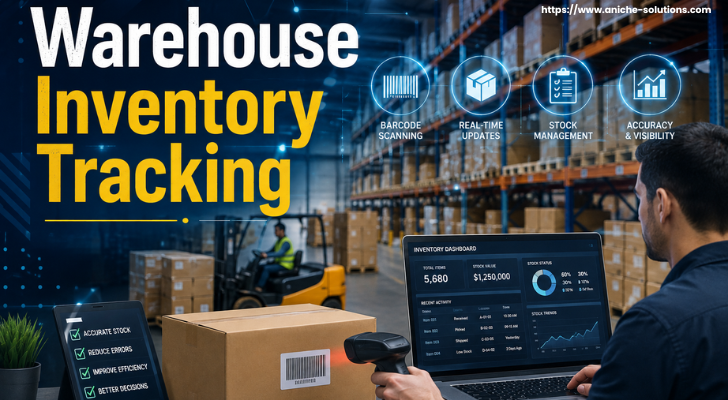
Inventory Tracking – WMS keeps real-time data of all products in the warehouse. It shows stock levels, locations, and movement history.
Order Management – WMS handles order picking, packing, and shipping. It ensures accurate and timely deliveries.
Storage Optimization – The system helps assign the best locations for products. This saves space and improves warehouse efficiency.
Barcode and RFID Integration – WMS uses barcode scanners or RFID tags to track items. This reduces errors and speeds up operations.
Labor Management – WMS monitors employee tasks and productivity. It helps assign work efficiently and track performance.
Reporting and Analytics – The system provides reports on inventory, orders, and warehouse performance. Managers can make better operational decisions.
Improved Inventory Accuracy – WMS tracks every item in the warehouse. This reduces errors and ensures the right products are available when needed.
Faster Order Fulfillment – WMS helps pick, pack, and ship orders quickly. Customers receive their orders on time, improving satisfaction.
Better Space Utilization – WMS organizes storage efficiently. It maximizes available space and keeps the warehouse neat.
Reduced Operational Costs – Automation and optimized workflows save time and labor costs. Fewer mistakes also lower losses.
Improved Reporting – WMS provides real-time reports on stock, orders, and employee performance. Managers can make informed decisions.
ERP and WMS are separate systems because enterprise-wide coordination and warehouse execution work at different levels. Using the same system for both can cause problems. For example, inventory may appear correct in financial reports, but delays in picking, packing, or shipping can occur. The key difference is that ERP manages business processes across departments, while WMS controls warehouse operations at the ground level.
An ERP system coordinates business activities across multiple departments. It handles procurement, production planning, financial postings, approvals, and reporting. ERP ensures data accuracy by reconciling transactions, forecasting demand, and supporting compliance.
A warehouse management system focuses entirely on warehouse execution. It governs how goods are received, stored, picked, packed, and shipped. Inventory cannot change state unless the physical action is confirmed on the warehouse floor. This ensures operational accuracy in real time.
This separation exists because warehouse execution needs immediate validation, while ERP works on enterprise-level stability and auditability.
ERP tracks inventory based on business records. Stock values update after transactions are completed and reflected in financial ledgers. This gives a clear picture of overall inventory value and availability for planning and reporting.
WMS tracks the physical state of inventory. It monitors items in specific locations, handles picking and packing status, and only updates when movements are confirmed. This level of control ensures that warehouse operations are accurate, and orders are fulfilled smoothly even if discrepancies appear at the enterprise level.
ERP provides a consolidated view of the entire business, allowing managers to analyze performance, costs, and operations. It works well for strategic planning but may not reflect real-time warehouse events.
WMS gives live visibility into warehouse processes. Managers can track item movements, monitor labor productivity, and ensure timely dispatch. This makes WMS critical for operational efficiency, while ERP ensures business-level coordination.
While ERP can function without a WMS, combining both systems provides full business and operational visibility. ERP manages finance, HR, sales, and reporting, while WMS ensures warehouse execution is accurate and fast. Integration allows businesses to maintain enterprise-wide data consistency without compromising warehouse control.
An ERP system is ideal for businesses that need to coordinate multiple departments and processes from a single platform. It works best when a company wants to integrate finance, sales, inventory, human resources, procurement, and production under one system.
Businesses should consider ERP when they face challenges such as duplicate data entry, delayed reporting, or lack of real-time visibility across departments. ERP helps reduce errors by centralizing information and ensuring that every team works with the same data.
Companies with complex operations, multiple locations, or high transaction volumes can benefit significantly from ERP. It allows leaders to monitor overall performance, make informed decisions, and plan strategically without manually gathering information from different departments.
In short, choose an ERP system when the main need is enterprise-wide coordination, accurate reporting, and improved workflow across the entire organization.
A warehouse management system is designed to streamline warehouse operations, improve accuracy, and optimize inventory management. But not every business needs a WMS right away. You should consider implementing a WMS when your current warehouse processes start to limit growth or efficiency.
If your business is experiencing frequent inventory errors, misplaced stock, or delayed order fulfillment, a WMS can help automate and track inventory in real time. Similarly, when your warehouse operations expand for example, managing multiple locations, handling increased order volumes, or integrating with e-commerce platforms a WMS becomes crucial for maintaining smooth operations.
Other indicators include difficulty in managing labor efficiently, lack of accurate reporting on inventory levels, or challenges in meeting customer delivery expectations. Choosing a WMS at the right time ensures better inventory visibility, faster order processing, and reduced operational costs, giving your business a competitive advantage.
Choosing between a warehouse management system and an enterprise resource planning system depends on the specific needs of your business. A WMS focuses primarily on optimizing warehouse operations, such as inventory tracking, picking and packing, storage management, and shipping efficiency. It is ideal if your main challenge is managing warehouse performance and order fulfillment.
On the other hand, an ERP system offers a broader business solution, integrating functions like finance, procurement, human resources, sales, and inventory management. ERP is suitable when you want a centralized platform to manage multiple departments, not just warehouse operations.
For many businesses, the choice isn’t strictly one or the other. Companies often use ERP for overall business management and integrate a WMS to handle detailed warehouse tasks. The key is to assess your priorities: if improving warehouse efficiency and accuracy is urgent, a WMS is the better choice; if you need a complete business management system, ERP is the way to go.
ERP and WMS systems are evolving to make business operations smarter and more efficient. AI and machine learning are helping automate tasks, predict demand, and optimize warehouse processes.
Cloud-based solutions are becoming standard, allowing real-time access to data, easy scaling, and reduced infrastructure costs. IoT devices like sensors and RFID tags improve inventory tracking and operational visibility.
Automation and robotics are transforming warehouses, speeding up order fulfillment and reducing manual labor. At the same time, better integration between ERP and WMS ensures smooth data flow across departments. Finally, mobile apps, voice-enabled operations, and improved user interfaces make systems easier to use, boost productivity, and support faster decision-making.
Yes, many businesses integrate WMS with ERP to manage warehouse tasks while keeping overall business operations centralized.
A WMS is better for optimizing warehouse processes, improving accuracy, and speeding up order fulfillment.
Choose ERP if you need a complete business management system covering multiple departments, not just warehouse operations.
Yes, many ERP and WMS solutions are cloud-based, offering real-time access, easy scaling, and remote management.
Yes, both systems are increasingly using AI, automation, and robotics to improve efficiency and decision-making.
ERP and WMS serve different but complementary purposes. ERP manages overall business processes, including finance, HR, sales, and inventory, providing a centralized view of operations. WMS focuses specifically on warehouse efficiency, real-time inventory tracking, and faster order fulfillment. Understanding these differences helps businesses choose the system that best fits their current needs.
For many growing companies, using ERP and WMS together provides the best results. ERP ensures enterprise-wide coordination, while WMS optimizes warehouse operations. By selecting the right system or integrating both businesses can improve accuracy, streamline workflows, reduce costs, and support long-term growth.

At A' Niche Solutions, we transform inventory management into a smart, automated, and future-ready process.
Quick Links
Products
Business Solutions
Gallery
Copyright 2025, A'Niche Infotech Solutions Pvt Ltd. All Right Reserved
Managed By