
Inventory management helps businesses keep track of the products they store and sell. Every company needs to know how much stock is available and where the products are located. Many businesses still depend on manual counting or barcode scanning to manage inventory, but these methods can take time and sometimes create mistakes in stock records.
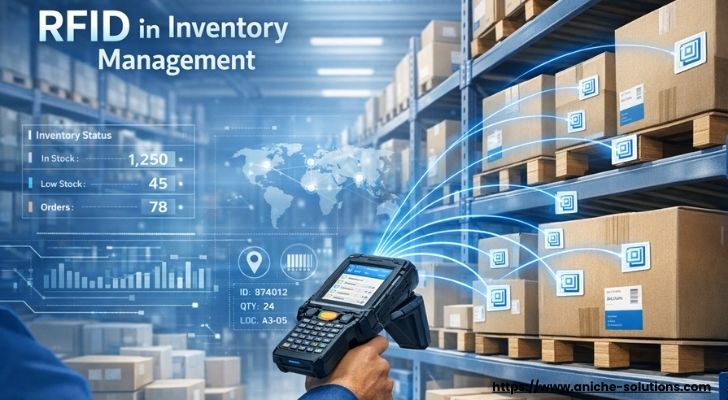
Radio Frequency Identification (RFID) technology provides a smarter way to manage stock. Many companies now use rfid in inventory management to track items automatically with the help of RFID tags and readers. This system allows products to be identified without scanning each item separately.
Businesses use RFID to maintain better inventory accuracy and improve stock visibility inside warehouses and stores. The system helps track product movement and reduces the effort required in daily inventory operations. In this blog, we will explain what is rfid in inventory management, its working process, key components, benefits, challenges, and its future use in different industries.
Radio Frequency Identification (RFID) is a technology that uses radio signals to identify and track objects. In simple words, what is rfid in inventory management refers to the use of RFID tags and readers to monitor products inside a warehouse, store, or storage facility. Each product is attached with a small RFID tag that contains a unique identification number.
When an RFID reader scans the area, it reads the information stored in the tag through radio waves. This process happens automatically without direct contact with the product. Because of this, businesses can track multiple items at the same time without scanning them one by one.
Many companies use rfid in inventory management to improve stock visibility and maintain accurate inventory records. The system helps businesses know the exact location and quantity of products in real time, which makes inventory control easier and faster.
A Radio Frequency Identification (RFID) inventory system works with several important components. Each component performs a specific role in identifying and tracking products. These components work together to make rfid in inventory management accurate and efficient.
RFID tags are small electronic chips attached to products or packaging. Each tag stores a unique identification number that helps identify the item in the inventory system. Tags can be passive, active, or semi-passive depending on the requirement.
RFID readers are devices that send radio signals to detect RFID tags. When a tagged product comes within the reader’s range, the reader captures the data stored in the tag. Readers can be installed at warehouse entry points or used as handheld devices by warehouse staff.
RFID printers are used to print labels and encode RFID tags with product information. These printers write data into the RFID chip and print the product label at the same time. Businesses use them to create RFID tags for inventory items before placing them in storage or sending them to warehouses.
RFID antennas help transmit signals between the tag and the reader. They increase the coverage area so the reader can detect multiple tags at the same time.
The software collects and manages the data received from RFID readers. It connects with the inventory management system and shows information like stock quantity, product location, and inventory movement.

The working process of rfid in inventory management involves several steps that help businesses track products from the moment they enter the warehouse until they move out. Each step ensures that inventory data is recorded correctly and updated in the system.
The process begins by creating RFID labels for products. RFID printers print the product label and write information into the chip at the same time. This information may include product ID, batch number, or serial number. After encoding, each tag carries a unique identity for that item.
Staff attach RFID tags to products, cartons, or pallets before placing them in storage. The tag becomes part of the product and stays with it during movement inside the warehouse or supply chain.
RFID readers installed at entry gates, shelves, or storage areas send radio signals to detect nearby tags. When tagged products come within the reader’s range, the reader collects the information stored in the RFID chip.
RFID technology allows readers to capture data from many tags at once. This means warehouse staff do not need to scan every item separately. The system can read several products in seconds while they move through the warehouse.
The information collected by the reader is sent to the RFID software system. The software processes the data and updates inventory records automatically.
The system updates stock quantity, product location, and movement details immediately. Managers and warehouse teams can check the latest inventory status through the dashboard.
Warehouse managers use the system to monitor product movement, check stock availability, and identify missing or misplaced items. This helps businesses maintain accurate inventory records and manage operations smoothly.
RFID technology allows companies to identify products automatically and update inventory records without manual scanning. The benefits of the rfid system in inventory management can be clearly seen in daily operations.
Inventory accuracy is one of the biggest advantages of RFID technology. In traditional systems, manual counting or barcode scanning can sometimes lead to mistakes in stock records. RFID systems read product data automatically through radio signals, which reduces the chances of human error.
RFID readers can scan many items at the same time without direct contact with the product. This makes the inventory counting process much faster compared to manual methods. Warehouse staff can check stock levels quickly and complete inventory audits in less time.
RFID systems provide real-time information about stock levels and product location. Managers can see where products are stored and how many items are available at any time. This helps businesses avoid problems like stock shortages or overstocking. Real-time visibility also improves planning and inventory control.
Manual inventory management requires a lot of time and physical effort from warehouse staff. RFID technology automates many of these tasks by collecting product data automatically. Staff members do not need to scan each item individually, which reduces workload and allows them to focus on other important warehouse activities.
RFID systems help businesses track product movement inside warehouses and distribution centers. If an item is misplaced or moved to the wrong location, the system can quickly identify the issue. This helps reduce inventory losses and improves product security. .
Many industries handle a large number of products every day. Managing such a large volume of inventory can be difficult without the right technology.
Retail businesses manage thousands of products across stores and warehouses. RFID helps retailers track product movement from the warehouse to store shelves. Store managers can quickly check stock availability and identify missing items. This helps improve product availability and reduces stock shortages.
Manufacturing companies use RFID systems to track raw materials, components, and finished goods. The system helps monitor inventory at different stages of production. Accurate inventory data helps manufacturers maintain smooth production processes and avoid delays caused by missing materials.
Hospitals and medical facilities manage many important supplies such as medicines, medical equipment, and surgical tools. RFID technology helps healthcare organizations track these items and maintain proper stock levels. This ensures that important medical supplies are available when needed.
Logistics companies handle large shipments and warehouse storage. RFID systems help track products as they move through warehouses and distribution centers. The technology helps warehouse teams locate items quickly and manage inventory more efficiently.
Automotive companies manage thousands of spare parts and components in their inventory. RFID helps track these parts across warehouses and assembly units. Accurate inventory tracking helps avoid production delays and ensures that the required components are available at the right time.
Many businesses may face some challenges while implementing RFID systems. These challenges usually appear during the setup stage or while integrating the system with existing inventory processes.
RFID systems require investment in hardware such as RFID tags, readers, antennas, printers, and software. The setup cost can be higher compared to traditional barcode systems. Small businesses may find it difficult to adopt the technology because of the initial expense.
Companies often use existing inventory management or warehouse management systems. Integrating RFID technology with these systems may require technical adjustments. Proper planning and technical support are required to make sure the systems work smoothly together.
Certain materials like metal and liquids can affect RFID signal performance. This may create difficulty in reading tags correctly in some environments. Businesses must select the right type of tags and place readers properly to avoid signal problems.
RFID systems collect a large amount of data from tags and readers. Businesses need proper software and data management practices to handle this information effectively. Without proper management, the large volume of data can become difficult to analyze.
Warehouse staff and system operators need proper training to use RFID technology effectively. Employees must understand how to manage RFID equipment and monitor inventory data. Training helps ensure smooth adoption of the system in daily operations.
Technology continues to change the way businesses manage inventory. Many companies are gradually shifting from manual tracking methods to automated systems. Because of this shift, rfid in inventory management is expected to become more common in warehouses, retail stores, and supply chain operations.
Businesses are now focusing on improving inventory visibility and operational efficiency. RFID technology allows companies to track products in real time and maintain accurate stock data. As more organizations adopt digital systems, the demand for RFID solutions in inventory management will continue to grow.
Integration with other technologies is also increasing the value of RFID systems. Many companies are connecting RFID with warehouse management systems and data analytics platforms to get better inventory insights. These developments show that RFID technology will continue to play an important role in modern inventory management in the coming years.
The main purpose of Radio Frequency Identification (RFID) is to identify and track objects automatically using radio signals. It helps businesses monitor products, assets, or inventory without manual scanning.
Warehouses use rfid in inventory management to track products, pallets, and cartons. RFID readers detect tagged items automatically when they move through storage areas, which helps update inventory records in real time.
Retail stores use RFID tags on products to track stock levels and product movement. The system helps store managers check inventory quickly and ensures that products are available on shelves.
RFID is faster because it can read multiple items at the same time without direct scanning. Barcode systems require manual scanning of each item. The choice depends on business needs and budget.
No, a normal magnet usually does not destroy an RFID chip. RFID tags are designed to handle common environmental conditions and magnetic exposure.
Inventory management is an important part of business operations, especially for companies that handle large volumes of products. Traditional tracking methods can take time and sometimes create errors in stock records. Because of this, many businesses are adopting rfid in inventory management to improve inventory tracking and maintain accurate stock data.
Radio Frequency Identification (RFID) technology allows businesses to track products automatically using tags, readers, and software systems. This helps companies monitor inventory movement, maintain real-time stock visibility, and reduce manual effort in warehouse operations.
As technology continues to develop, more industries are expected to adopt RFID systems for better inventory control. Businesses that implement RFID solutions can manage stock more efficiently and improve their overall inventory management process.

At A' Niche Solutions, we transform inventory management into a smart, automated, and future-ready process.
Quick Links
Products
Business Solutions
Gallery
Copyright 2025, A'Niche Infotech Solutions Pvt Ltd. All Right Reserved
Managed By