Many businesses today use automatic identification systems to track products, manage inventory, and improve operations. Two of the most common technologies are barcodes and RFID. Both help in identifying items, but they work in very different ways.
When people compare rfid vs barcode, they often get confused about which one is better. The truth is, both have their own benefits and limits. The right choice depends on your business size, budget, and tracking needs.
In this blog, we will clearly explain the difference between rfid tag vs barcode, how they work, their advantages and disadvantages, and where they are commonly used in business.
Radio Frequency Identification, commonly known as RFID, is a technology that uses radio waves to identify and track objects automatically. It does not require direct contact or line of sight to scan items.
An RFID system mainly includes three parts: an RFID tag, a reader, and a software system. The tag is attached to the product. The reader sends radio signals and collects data from the tag. The software then stores and manages that data.
When people compare rfid vs barcode, one major difference is that RFID can scan multiple items at the same time without physically pointing a scanner at each item. This makes it useful for businesses that handle large volumes of goods.
RFID systems are mainly divided into three types based on how the tag gets power and sends data. Each type is designed for different business needs and budgets.
Passive RFID : Passive RFID tags do not have their own battery. They receive power from the RFID reader’s signal and then send back stored information. These tags are small, lightweight, and affordable.
Many retail stores and warehouses use passive RFID for inventory tracking. The reading range is shorter compared to other types, but the low cost makes it suitable for large-scale use. When comparing rfid tag vs barcode, passive RFID is often chosen where businesses want automation without very high investment.
Active RFID : Active RFID tags come with a built-in battery. This battery allows the tag to send signals over a longer distance without depending fully on the reader.
Companies use active RFID to track vehicles, containers, and expensive equipment. The range can go up to hundreds of meters. The cost is higher, so it is mostly used for high-value assets.
Semi-Passive RFID : Semi-passive RFID tags also have a battery, but they use the reader’s signal to communicate. The battery mainly supports the internal circuit of the tag.
These tags offer better performance than passive RFID and cost less than active RFID. Businesses choose this type when they need moderate range and better data reliability.
RFID offers many practical benefits for businesses that need fast and reliable tracking. Below are the main advantages:
No line of sight required : RFID tags can be scanned without directly pointing the reader at them. Items inside boxes or pallets can still be detected.
Multiple items scanned at once : A single RFID reader can capture data from many tags at the same time. This saves a lot of time in warehouses and retail stores.
Faster processing : Scanning happens automatically and quickly. Staff do not need to scan each item one by one like in barcode systems.
Improved accuracy : Automated data capture reduces manual errors. Inventory records stay more accurate.
Better inventory visibility : Real-time tracking helps businesses know the exact location of goods. This improves stock control.
RFID is useful, but it also has some drawbacks. Businesses should understand these limits before choosing between rfid vs barcode.
Higher initial cost : RFID tags and readers are more expensive than barcode labels and scanners. Setup cost can be high for small businesses.
Complex setup : Installation and system integration require technical knowledge. Staff may need training to manage the system properly.
Signal interference : Metal surfaces and liquids can affect radio signals. This may reduce reading accuracy in certain environments.
Privacy concerns : Some people worry about unauthorized scanning of RFID tags, especially in retail use.
Maintenance cost : Active RFID tags use batteries, and those batteries need replacement after some time.
RFID works through communication between a tag and a reader using radio waves. The process is simple but very effective for automatic tracking.
First, the RFID reader sends out a radio signal. When an RFID tag comes within range, it receives this signal. The tag then sends back the stored information, such as product ID or serial number.
The reader captures this data and sends it to a software system. The software stores the information and updates records in real time. This allows businesses to track items without manual scanning.
When comparing the both, one major difference is that RFID does not need direct scanning. Items can be identified even if they are not visible to the scanner. This makes the system faster and more suitable for bulk operations.
Barcodes are printed codes made of lines, spaces, or small squares that store product information. A scanner reads these codes and converts them into digital data.
Most products in retail stores have a barcode printed on the packaging. When scanned, the system quickly shows details like price, product name, and stock status. This makes billing and inventory tracking easier.
Barcodes are simple and cost-effective. A printed label and a basic scanner are enough to start using the system. That is why many small and medium businesses prefer barcodes when comparing barcodes vs rfid.
When people compare it, barcodes are often seen as the more affordable and easy-to-use option for everyday business needs.
Barcodes are mainly divided into two types based on how they store data. Each type is used in different industries depending on the amount of information required and the scanning purpose.
1D Barcodes (Linear Barcodes) : 1D barcodes are the traditional barcodes made of vertical black lines and white spaces. These lines represent numbers and basic product information. They are commonly used in retail stores for billing and inventory control.
Examples include Universal Product Code (UPC) and Code 128. These barcodes are easy to print and scan. Most supermarkets and small shops rely on them because they are affordable and simple to manage.
2D Barcodes : 2D barcodes store information in small squares, dots, or patterns instead of simple lines. They can hold much more data compared to 1D barcodes. This makes them suitable for storing product details, links, serial numbers, and other information.
A common example is the QR code. Businesses use it for digital payments, product authentication, tracking, and marketing campaigns. A single 2D barcode can store text, numbers, and even website URLs in a compact format.
Barcodes are widely used because they are simple and practical. Many businesses prefer them when comparing rfid vs barcode, especially if the budget is limited.
Low cost : Barcode labels are inexpensive to print. Scanners are also affordable, which makes the system suitable for small and medium businesses.
Easy to use : Staff can learn barcode scanning quickly. The process does not require technical expertise or complex training.
Quick scanning : A barcode scanner reads product information within seconds. This speeds up billing and inventory updates.
Accurate data entry : Manual typing errors are reduced because the scanner directly captures product information.
Simple setup : Businesses can start using barcodes without heavy investment in infrastructure or software changes.
Barcodes are simple and affordable, but they also have some limitations. Businesses should understand these points before deciding between barcodes vs rfid.
Line of sight required : A barcode must be clearly visible to the scanner. If the label is covered, damaged, or placed incorrectly, scanning becomes difficult.
One item at a time scanning : Each product needs to be scanned separately. This can slow down operations in large warehouses.
Limited data storage : Traditional barcodes store only basic information. They cannot hold large amounts of data like RFID tags.
Label damage risk : Barcode labels can get scratched, torn, or faded. A damaged barcode may not scan properly.
Manual effort required : Staff must physically point the scanner at every item. This increases time and labor in bulk handling.
A barcode works by converting printed patterns into digital information. The process is simple and widely used in retail and warehouses.
First, a barcode is printed on a product label or packaging. The barcode contains numbers or characters encoded in lines or patterns. Each pattern represents specific product data.
Next, a scanner reads the barcode using a light source, usually a laser or LED. The scanner detects the reflected light from the black and white spaces. It then converts this pattern into digital data.
Finally, the system sends the information to a computer or billing software. The product details such as name, price, and stock level appear instantly on the screen.
When we compare, one clear difference is that barcode scanning requires direct visibility and manual effort, while RFID works through radio signals without direct contact.
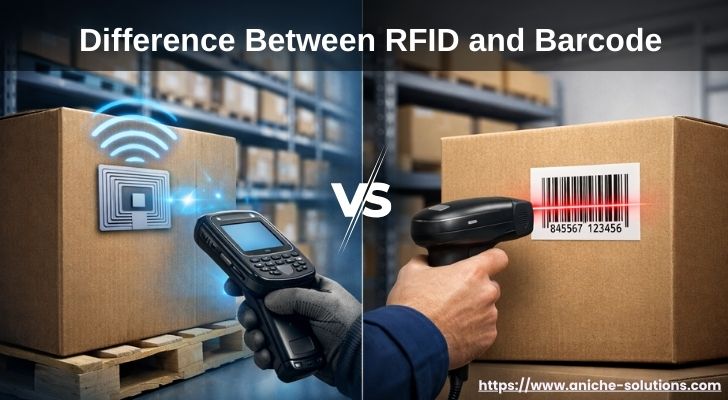
When comparing rfid vs barcode, it is important to understand how each technology works and where they differ. Both help in identifying and tracking items, but their methods and capabilities are very different.
RFID uses radio frequency signals to transmit data from a tag to a reader. The tag contains information about the product, which the reader collects automatically. This allows for wireless communication and fast data capture.
Barcodes, on the other hand, use printed lines or patterns. A scanner shines a light on the barcode and interprets the reflected pattern as data. Unlike RFID, barcodes rely entirely on optical scanning.
One of the major differences between RFID and barcodes is visibility. RFID does not need direct line of sight. The reader can detect tags even if they are hidden inside boxes, pallets, or behind other items.
Barcodes require direct visibility to the scanner. If the label is covered, torn, or faded, the scanner cannot read it. This limitation can slow down operations in large warehouses or fast-moving retail environments.
RFID is faster because multiple tags can be scanned at the same time. This reduces manual effort and speeds up processes like inventory checks or shipment tracking.
Barcodes scan one item at a time, which takes more time in large operations. For small shops or businesses with limited stock, this may not be a problem, but for high-volume warehouses, RFID provides a clear advantage.
RFID tags can store a significant amount of data, including product details, serial numbers, and even status information. Some RFID tags can be updated to change the stored information.
Barcodes store limited information, usually just a product ID number or SKU. Any additional information must be linked to a database, making barcodes less flexible for detailed tracking.
Cost is another difference. RFID systems are more expensive due to the price of tags, readers, and installation. They also may require staff training and software integration.
Barcodes are affordable and easy to implement. A simple printed label and a basic scanner are enough to start using a barcode system. This makes barcodes ideal for small to medium-sized businesses with limited budgets.
RFID tags are durable and can withstand harsh environments, such as extreme temperatures, moisture, or rough handling.
Barcode labels are prone to damage. Scratches, tears, or fading can make a barcode unreadable, requiring replacement or re-labeling.
RFID supports a higher level of automation. Inventory counts, shipment tracking, and product identification can happen automatically without manual intervention.
Barcodes require staff to scan each item individually, which increases labor and time costs.
Here’s a concise table summarizing the detailed differences between RFID and Barcodes:
 Common Uses of RFID in Business
RFID technology is widely used across industries because it provides fast, accurate, and automated tracking. Here is a detailed look at its key applications:
Retail stores, warehouses, and distribution centers use RFID with an inventory management system to manage stock in real time. Each product is tagged with an RFID chip, which allows the system to automatically track inventory levels, movements, and locations.
RFID plays a major role in the supply chain. Products are tagged at manufacturing, and their movement is tracked through warehouses, transport, and delivery points.
In retail, RFID enhances operations beyond inventory management. It enables faster checkout by scanning multiple items at once, reduces theft with improved tracking, and supports smart shelves that detect when stock is low.
Companies with expensive or critical assets rely on RFID in an assets management system to monitor machinery, vehicles, or IT equipment continuously. RFID tags help track where an asset is located, when it is being used, and its maintenance schedule.
Barcodes remain one of the simplest and most cost-effective methods for product identification and tracking. Many businesses still rely on them for daily operations due to ease of use and low setup cost.
Retail stores use barcodes at checkout counters for faster billing. Scanning a product’s barcode instantly pulls up price and product details in the POS system. This reduces manual entry errors and improves customer service.
Barcodes are widely used to track shipments, pallets, and packages. Scanning barcodes at each stage of the supply chain allows businesses to monitor the movement of goods and maintain accurate records.
Hospitals and clinics use barcodes for patient wristbands, medicines, and laboratory samples. This ensures accurate identification, reduces human errors, and improves safety.
Barcodes are used in tickets and passes for events. Scanning them at entry points ensures smooth access control and attendance tracking.
Choosing between barcodes vs RFID depends on your business needs, budget, and the type of operations you manage. Both technologies have their strengths and limitations.
If your business handles large volumes of products or assets, needs real-time tracking, and wants to reduce manual labor, RFID is the better choice. It works without line of sight, scans multiple items at once, and stores more data. Industries like warehousing, supply chain, retail, and healthcare often prefer RFID for efficiency and automation.
On the other hand, barcodes are ideal for smaller operations or businesses with budget constraints. They are easy to implement, low cost, and sufficient for basic tracking needs. Retail stores, small warehouses, and offices can rely on barcodes for inventory management, asset tracking, and billing without heavy investment.
Sometimes businesses use a combination of both. Barcodes can handle everyday items, while RFID can track high-value assets or bulk shipments. Evaluating your operational scale, cost, and tracking requirements will help you choose the right system.
Yes, RFID is faster because it can scan multiple items at once without line of sight. Barcodes must be scanned one by one.
Not completely. RFID is better for large-scale operations and automation, but barcodes remain cost-effective for small businesses and everyday use.
No, RFID systems are more expensive due to the cost of tags, readers, and setup. Barcodes are low cost and easy to implement.
QR codes can store more information than traditional barcodes. They are better for sharing links, detailed product info, or digital applications.
It depends on the use. 1D barcodes are good for simple product identification. 2D barcodes, like QR codes, are better for storing more data and for digital applications.
Both RFID and barcodes are effective tools for identifying and tracking products or assets, but they serve different purposes. RFID is ideal for large-scale operations that require speed, automation, and detailed data storage. Barcodes are simpler, low-cost, and suitable for small to medium businesses with basic tracking needs.
When choosing between barcodes vs rfid, consider your business size, budget, and operational requirements. Some businesses even use both systems together to get the benefits of speed, accuracy, and affordability.
By understanding the differences between rfid tag and barcode, companies can make the right choice and improve efficiency in inventory management, asset tracking, and supply chain operations.

At A' Niche Solutions, we transform inventory management into a smart, automated, and future-ready process.
Quick Links
Products
Business Solutions
Gallery
Copyright 2025, A'Niche Infotech Solutions Pvt Ltd. All Right Reserved
Managed By