Inventory management plays an important role in keeping products available while controlling storage costs. Businesses need to track stock, predict demand, and decide when to reorder products.
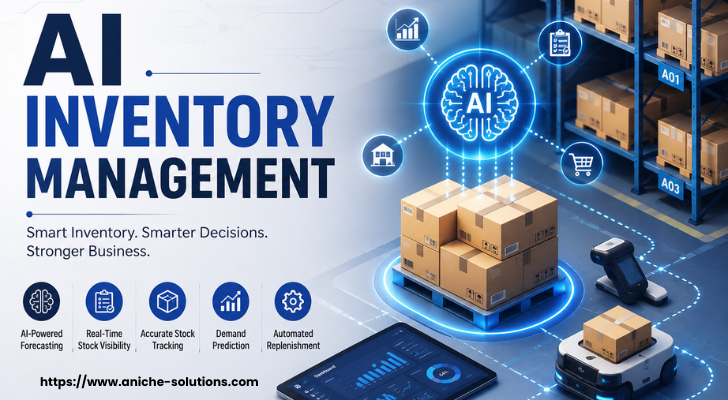
AI inventory management uses artificial intelligence to handle these tasks with the help of data, patterns, and automated systems. AI can analyse sales history, stock levels, customer demand, and other business data to support better inventory decisions.
The use of AI in inventory management system can help businesses predict future demand, identify stock issues, automate replenishment, and reduce manual work. These capabilities make inventory processes faster and more data-driven.
But how is AI used in inventory management in real business situations? This guide covers the main applications, benefits, challenges, technologies, implementation steps, and future scope of AI-powered inventory management.
AI inventory management is the use of artificial intelligence to monitor, analyse, and manage inventory-related tasks. It uses business data to help companies make better decisions about stock levels, purchasing, storage, and demand.
Traditional inventory systems mainly depend on fixed rules and manual data analysis. AI-based systems can study large amounts of data and identify patterns that may be difficult to spot manually.
For example, AI can analyse past sales, seasonal demand, product movement, and current stock levels. Based on this data, it can estimate future demand and suggest when a business should reorder products.
The use of AI in inventory management systems can also support automated stock monitoring and alerts. This helps businesses respond to inventory changes faster and keep the right amount of stock available.
In simple terms, AI adds intelligence to the inventory process. It helps businesses move from basic stock tracking to data-based inventory planning and decision-making.
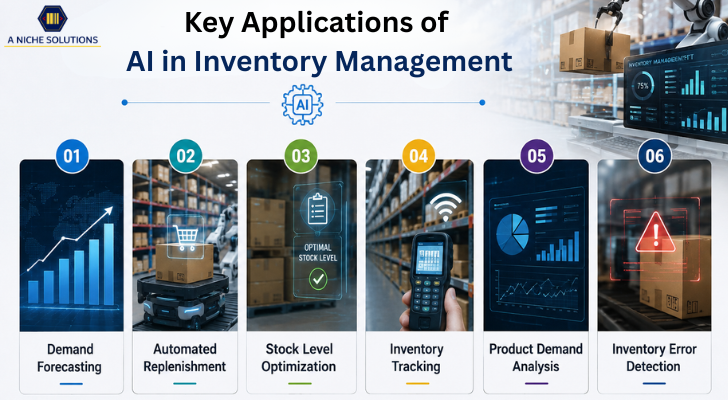
AI can support different parts of the inventory process, from demand planning to stock monitoring. Businesses can use it to reduce manual tasks and make inventory decisions based on real-time and historical data.
AI can analyse past sales, seasonal trends, customer demand, and other data to estimate future product demand. This helps businesses plan stock levels before demand changes.
AI systems can monitor stock levels and identify when products need to be reordered. They can also suggest suitable reorder quantities based on demand and inventory data.
AI helps businesses maintain suitable stock levels for different products. It can identify slow-moving and fast-moving items and support better stock allocation.
AI can work with inventory data to track stock movement across warehouses and locations. Businesses can get a clearer view of available, incoming, and outgoing inventory.
AI can identify changes in buying patterns and product demand. These insights help businesses understand which products may need more or less stock.
AI can identify unusual changes in inventory data, such as unexpected stock movements or differences between recorded and actual stock. This can help teams check problems before they become bigger issues.
AI can help businesses manage inventory with better planning, faster decisions, and less manual effort. Its benefits can be useful for both small businesses and large operations with multiple warehouses or product lines.
AI can analyse sales history, seasonal changes, and customer demand to predict future inventory needs. Better forecasts can help businesses prepare stock based on expected demand.
AI can identify products that may run out based on current stock and demand patterns. Early alerts can give businesses more time to reorder products and maintain availability.
AI can automate tasks such as stock monitoring, demand analysis, and reorder recommendations. This allows inventory teams to spend less time on repetitive work.
AI can analyse inventory data and identify unusual changes or possible errors. This can support more accurate stock records and better control over inventory.
AI can process large amounts of inventory data quickly. Businesses can use these insights to make faster decisions about purchasing, replenishment, and stock allocation.
AI can bring several benefits to inventory operations, but its implementation also comes with some challenges. Businesses need the right data, systems, and people to get useful results from AI.
AI depends on accurate and complete data. Incorrect stock records, missing sales data, or outdated information can affect forecasts and recommendations.
Many businesses already use ERP, WMS, POS, or other inventory systems. Connecting AI tools with these systems can require technical changes and careful planning.
AI implementation may require investment in software, system integration, data preparation, and employee training. The cost can be a concern for businesses with limited budgets.
Employees need to understand how AI-based tools work and how to use their recommendations. Proper training can help teams use the technology with confidence.
Inventory systems can contain important business information, including sales, supplier, and customer data. Businesses need suitable security measures to protect this information.
AI recommendations are based on the data and models used by the system. Changes in customer demand, market conditions, or supply issues may affect the accuracy of predictions.
AI inventory systems use several technologies to collect data, identify patterns, and support inventory decisions. These technologies work together to make inventory management more automated and data-driven.
Machine learning allows systems to learn from historical inventory and sales data. It can identify patterns and improve demand forecasts as more data becomes available.
Predictive analytics uses past and current data to estimate future inventory needs. Businesses can use these predictions for demand planning, purchasing, and stock replenishment.
IoT devices such as smart sensors and connected scanners can collect real-time information about inventory and warehouse operations. This data can then be used by AI systems for analysis.
Computer vision uses cameras and image processing to identify and track products. It can support tasks such as stock counting, product identification, and warehouse monitoring.
Natural language processing allows AI systems to understand and respond to human language. It can be used in inventory dashboards, reporting tools, and AI assistants that help employees access inventory information.
Cloud platforms provide the storage and computing power needed to process large amounts of inventory data. They also make it easier to connect AI tools with different business systems.
AI is used in inventory management to analyse sales, stock levels, customer demand, and supplier data. It helps businesses make faster and more informed inventory decisions.
AI can predict product demand by studying past sales and buying patterns. It can also monitor stock levels and suggest when products need to be reordered.
Businesses can use AI to identify fast-moving and slow-moving products. This helps them maintain the right stock levels and reduce unnecessary inventory.
AI can also track inventory across multiple warehouses and identify unusual stock changes. These insights help teams manage purchasing, replenishment, and stock allocation more effectively.
Overall, how AI is used in inventory management depends on the business needs, but its main purpose is to make inventory planning and control more accurate and data-driven.
AI implementation works better when businesses follow a clear process. The right approach can help teams choose suitable technology and use it effectively.
Start by identifying the main inventory problems, such as stockouts, excess stock, inaccurate records, or poor demand forecasting.
Collect accurate data related to sales, stock levels, orders, suppliers, and product movement. Good-quality data is important for useful AI results.
Select an AI inventory solution based on business size, inventory needs, existing systems, and budget.
Give employees proper training on the new system and explain how they can use AI recommendations in their daily work.
Track the system's performance and review its results regularly. Businesses can make adjustments as their inventory needs change.
AI is expected to play a bigger role in inventory management system as businesses collect more data and adopt smarter digital systems. Future AI tools will focus on faster analysis, better predictions, and more automated inventory decisions.
AI can help businesses respond to changes in customer demand, supply delays, and market conditions in near real time. Integration with IoT devices, robotics, warehouse systems, and cloud platforms can also make inventory operations more connected.
The future of AI inventory management will move beyond basic stock tracking. AI will support businesses in predicting inventory needs, improving replenishment decisions, and managing stock across multiple locations with less manual effort.
Businesses that adopt AI with good-quality data and the right systems can build more responsive and data-driven inventory processes.
Yes. AI can analyse historical sales, seasonal trends, customer buying patterns, and other data to estimate future product demand.
Yes. AI can monitor stock levels and demand patterns to recommend when products should be reordered and how much stock may be required.
AI inventory management can be used across industries such as retail, manufacturing, healthcare, e-commerce, logistics, and distribution, depending on the business's inventory needs.
AI analyses historical sales, current stock levels, seasonal trends, and demand patterns to forecast future inventory requirements. This helps businesses plan purchases and stock levels more effectively.
AI can predict demand and monitor stock levels to identify possible shortages or excess inventory. Businesses can use these insights to reorder products at the right time and maintain balanced stock levels.
AI is changing the way businesses manage inventory by making stock planning and monitoring more data-driven. It can help with demand forecasting, replenishment, inventory tracking, and stock-level management.
The use of AI in inventory management system can reduce manual work, support better decisions, and help businesses maintain the right amount of stock.
With the right data, technology, and implementation plan, AI inventory management can become a useful part of modern inventory operations and help businesses manage changing demand more effectively.

At A' Niche Solutions, we transform inventory management into a smart, automated, and future-ready process.
Copyright 2025, A'Niche Infotech Solutions Pvt Ltd. All Right Reserved
Managed By