Inventory management becomes more challenging when a business operates from different locations. Many companies today manage stock across warehouses, retail stores, fulfillment centers, and distribution hubs simultaneously. Keeping track of inventory manually across all these locations can lead to stock confusion, delayed deliveries, and order errors.
This is where multi-location inventory management helps businesses manage stock in a more organized way. It allows companies to track inventory movement, stock availability, and product transfers across different locations from a single system.
Reliable multi-location inventory management software helps businesses maintain accurate inventory records, reduce stock issues, and improve order fulfillment. It also helps teams make better decisions about restocking and inventory planning.
In this blog, we will understand what multi-location inventory management is, why it is important for businesses, its benefits, common challenges, and the best practices to manage inventory across multiple locations effectively.
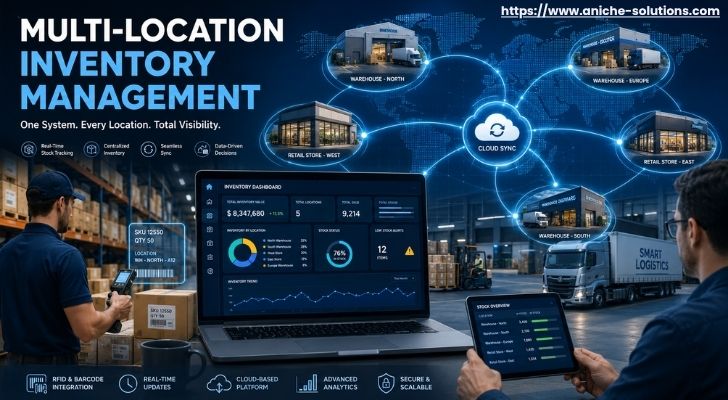
Multi-location inventory management is the process of managing and tracking inventory stored at different business locations through one system. These locations can include warehouses, retail stores, distribution centers, or fulfillment hubs.
Businesses use this method to know how much stock is available at each location in real time. It helps teams manage product movement, restocking, order fulfillment, and inventory transfers without confusion.
For example, a company may store products in warehouses located in Mumbai, Delhi, and Bangalore. With a proper multi-location inventory management software, the business can check stock availability at every location from one dashboard instead of managing separate records manually.
This system helps businesses maintain accurate inventory data across all locations. It also supports faster deliveries because orders can be shipped from the nearest available warehouse or store.
Many growing businesses prefer multi-location inventory management because it improves stock visibility and helps maintain better control over inventory operations.
Managing inventory across multiple locations is important for businesses that want smooth operations and better stock control. As businesses grow, handling inventory manually at different warehouses or stores becomes difficult and time-consuming.
A proper multi locations inventory management system helps businesses keep accurate stock records across all locations. Teams can quickly check product availability, stock movement, and low inventory levels without depending on manual updates.
Better inventory visibility also helps businesses avoid common problems like overstocking and stock shortages. When inventory data stays updated in real time, businesses can make faster decisions related to purchasing and restocking.
Customer satisfaction also improves with proper inventory management. Orders can be fulfilled from the nearest location, which helps reduce delivery time and shipping costs.
Using a reliable multi location inventory management software also improves coordination between warehouses, stores, and logistics teams. This creates a smoother workflow and reduces operational errors in daily business activities.
Businesses need multi-location inventory management to manage inventory smoothly across warehouses, retail stores, and distribution centers. When stock is stored at different locations, manual tracking becomes difficult and increases the chances of inventory mistakes. A proper system helps businesses monitor stock levels, product movement, and inventory availability from one place.
Growing businesses often serve customers from different cities or regions. In such cases, products must be available at nearby locations for faster order fulfillment. Using multi-location inventory management helps businesses reduce delivery delays, manage stock transfers easily, and avoid problems like stock shortages or excess inventory at certain locations.
A reliable multi-location inventory management software also helps businesses improve inventory planning and daily operations. Teams can get real-time stock updates, manage restocking properly, and fulfill customer orders with better accuracy. This saves time, reduces manual work, and keeps inventory operations more organized.
Managing inventory across multiple locations helps businesses improve stock control and daily operations. Below are some of the major benefits of using multi-location inventory management for growing businesses.
Businesses can track inventory across all locations from one centralized system. This gives teams complete visibility of stock levels, product movement, and inventory availability at every warehouse or store.
Better visibility helps businesses avoid confusion during order processing and restocking. Teams can quickly check which location has available stock and make faster decisions without depending on manual updates.
Customers expect quick deliveries, especially in today’s competitive market. Multi-location inventory management helps businesses fulfill orders faster by shipping products from the nearest available location.
This reduces delivery time and lowers transportation costs. Faster order fulfillment also improves customer satisfaction because customers receive products on time without unnecessary delays.
Managing inventory across multiple locations manually often creates stock imbalance. Some locations may face product shortages while others keep excess stock for a long time.
Using multi-location inventory management helps businesses maintain balanced inventory levels across all locations. Inventory can be transferred between warehouses based on stock availability and customer demand.
Accurate inventory records are important for smooth business operations. Manual inventory tracking increases the chances of mistakes in stock counting and order management.
A reliable multi-location inventory management software automatically updates inventory records whenever stock moves between locations or customer orders are processed. This helps businesses maintain accurate inventory data at all times.
As businesses grow, managing inventory from multiple locations becomes more challenging. Multi-location inventory management provides a structured system that supports business expansion without creating inventory management issues.
Businesses can easily add new warehouses, retail stores, or fulfillment centers while keeping inventory operations organized. Centralized inventory management also improves coordination between different locations and helps businesses scale operations more efficiently.
Managing inventory across multiple locations helps businesses improve operations, but it also creates several challenges. Below are some common challenges businesses face in multi-location inventory management.
Managing stock at different warehouses or stores becomes difficult when inventory records are updated manually. Businesses may struggle to know the exact stock availability at each location.
Lack of real-time inventory tracking can create confusion during order processing and restocking. This may lead to incorrect stock information and poor inventory decisions.
Some locations may have excess inventory while others face stock shortages. This happens when businesses do not properly monitor product demand and inventory movement across locations.
Stock imbalance affects order fulfillment and may increase storage costs. Businesses may also lose sales when products are unavailable at certain locations.
Inventory data must stay updated whenever products are sold, transferred, or restocked. Delayed updates can create errors in stock records and affect business operations.
Using manual spreadsheets or disconnected systems often slows down inventory updates. A proper multi-location inventory management software helps businesses reduce this problem through real-time stock synchronization.
Managing customer orders from multiple locations can become complicated when businesses do not have proper inventory visibility. Teams may process orders from locations where stock is unavailable.
This creates delivery delays, order cancellations, and poor customer experience. Faster and more accurate order fulfillment becomes difficult without centralized inventory management.
Businesses often transfer products between warehouses or stores to balance inventory levels. Managing these transfers manually increases the chances of tracking errors and stock mismatches. Poor transfer management can also create delays in product availability and affect inventory planning across locations.
A structured process helps improve stock control, reduce errors, and maintain smooth operations across warehouses, stores, and fulfillment centers. Below are some useful practices for effective multi-site inventory management.
Businesses should use a centralized system to manage inventory across all locations. A reliable multi-location inventory management software helps teams track stock levels, inventory movement, and order updates from one platform. Centralized inventory management reduces manual work and improves inventory accuracy across all business locations.
Real-time inventory tracking helps businesses maintain accurate stock records. Teams can quickly identify low stock levels, product movement, and available inventory at different locations. Regular inventory monitoring also helps businesses avoid stock shortages, overstocking, and order fulfillment issues.
Businesses should analyze product demand at each location and maintain inventory accordingly. Keeping balanced stock levels helps avoid unnecessary storage costs and improves order fulfillment efficiency. Inventory planning based on actual sales data also supports better purchasing decisions.
Regular inventory audits help businesses identify stock mismatches and inventory errors. Physical stock verification should be done frequently to maintain accurate inventory records. Audits also help businesses identify slow-moving products, damaged inventory, and operational issues at different locations.
Strong communication between warehouses, stores, and logistics teams is important for smooth inventory operations. Proper coordination helps businesses manage stock transfers, restocking, and order fulfillment more efficiently. Good coordination also reduces delays and improves overall workflow in multi-location inventory management.
A’Niche Solutions provides inventory and warehouse management solutions that help businesses manage inventory across multiple locations more efficiently. Businesses handling stock in warehouses, retail stores, or distribution centers often face challenges like stock mismatches, delayed updates, and inventory visibility issues.
A’Niche Solutions helps businesses simplify these operations through centralized inventory management systems. Businesses can track inventory levels, monitor stock movement, and manage inventory transfers from one platform. This improves inventory accuracy and reduces manual work across different locations.
The company also supports businesses with real-time inventory tracking, warehouse coordination, and order management processes. These solutions help businesses improve stock control, reduce operational delays, and maintain smoother inventory operations.
With proper multi-location inventory management software, businesses can manage growing inventory needs more effectively and maintain better control over daily inventory activities across all locations.
Businesses manage inventory across multiple locations by using a centralized inventory system that tracks stock levels, product movement, and inventory updates from all warehouses or stores in one place.
Businesses can avoid stock shortages by monitoring inventory in real time, maintaining proper stock levels at every location, and transferring inventory based on product demand.
It helps businesses reduce excess inventory, minimize storage costs, improve inventory planning, and avoid losses caused by incorrect stock management.
Industries like retail, e-commerce, manufacturing, logistics, wholesale distribution, and healthcare commonly use multi-location inventory management to manage inventory efficiently across different locations.
Managing inventory across different locations becomes difficult when businesses depend on manual tracking or disconnected systems. Proper inventory management helps businesses maintain accurate stock records, reduce operational issues, and improve order fulfillment across warehouses, stores, and fulfillment centers.
Using the right multi-location inventory management process helps businesses improve inventory visibility, maintain balanced stock levels, and manage inventory movement more efficiently. It also supports faster deliveries and better customer service.
A reliable multi-location inventory management software helps businesses simplify daily inventory operations through centralized inventory control and real-time stock tracking. As businesses continue to grow, managing inventory efficiently across multiple locations becomes important for smooth and organized operations.

At A' Niche Solutions, we transform inventory management into a smart, automated, and future-ready process.
Quick Links
Products
Business Solutions
Gallery
Copyright 2025, A'Niche Infotech Solutions Pvt Ltd. All Right Reserved
Managed By